The decisions hidden inside a video
An AI-assisted sign-language Bible can involve several quite different operations. Software can assist human performances, alter a presenter’s appearance or attempt to generate the language itself. Calling all three “AI translation” conceals who actually decides what Scripture says.
That distinction matters for churches funding accessible resources. A polished avatar demonstrates that a video can be produced. It does not, by itself, establish that the language is intelligible, that a signer agreed to every reuse, or that the intended community wanted this presentation. Conversely, a synthetic appearance need not mean that a machine authored the translation. Human linguistic work may sit beneath the rendered surface.
The useful question is therefore where control resides throughout production. That makes room for genuine technical benefits while resisting a familiar institutional mistake: measuring access by what a publisher has supplied rather than by what people can understand, challenge and use.
What the ministry demonstration actually showed
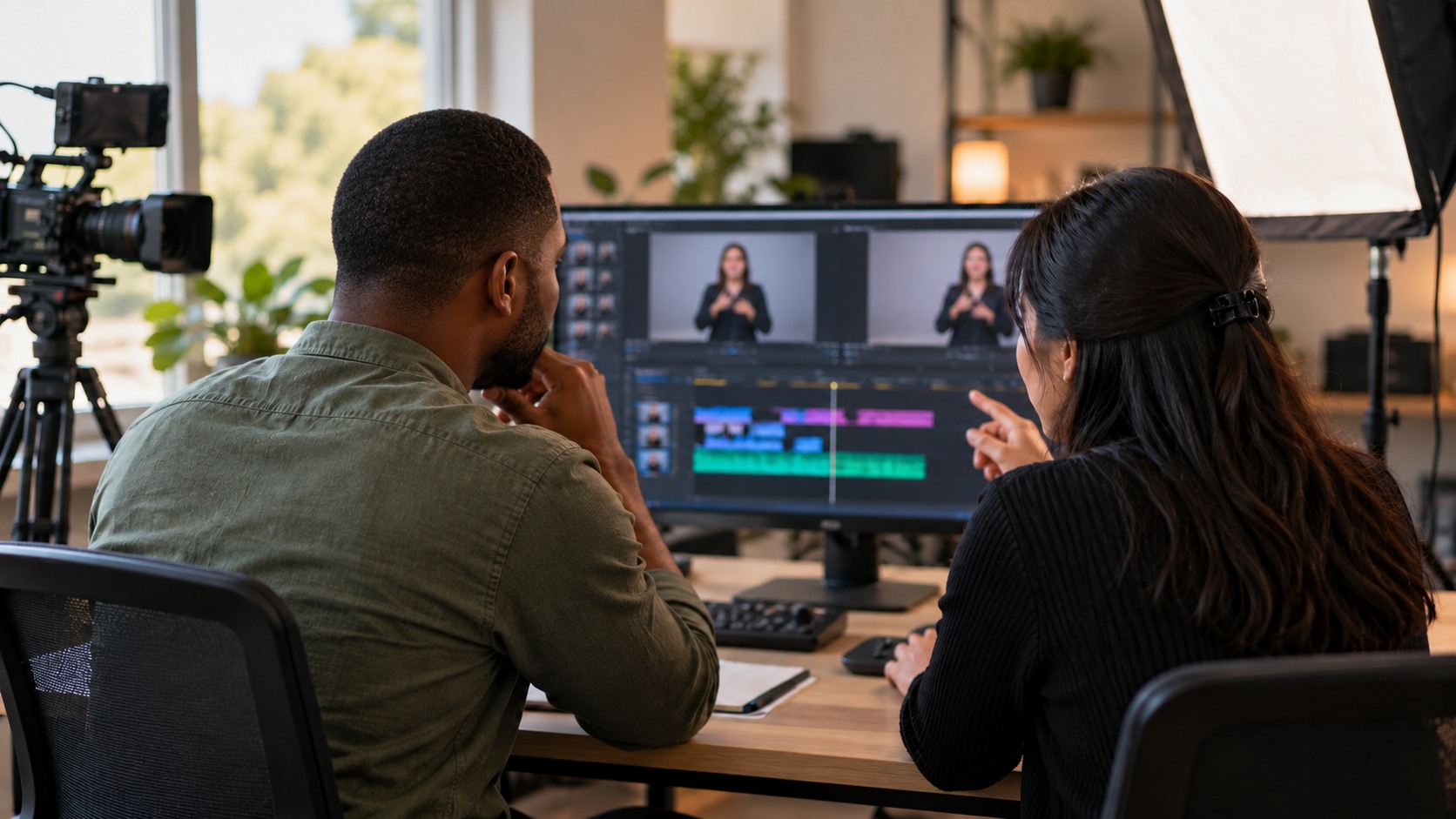
Wycliffe Global Alliance’s May 20, 2025 report described a presentation by DOOR International’s Caio Cascaes at that year’s Missional AI Summit. Its examples concerned different production tasks. Chameleon captured human signing without the marking sensors used in earlier workflows, then produced avatars. Lava, described at the time as under development by SIL, animated a different likeness using signing motion. Avodah Connect was developing ways to find and replace signs without rerecording an entire video.
The report also recorded a serious reason for altering appearance: protecting signers whose identification could put them at risk. That is a stated use case, not evidence that every resulting system provides effective anonymity. The report does not supply a security audit or comprehension trial. The page also displays a March 10, 2026 date. Neither date establishes the products’ status today; this is an account of the 2025 presentation. Read the original account: Source: wycliffe.net
These examples reveal why a blanket judgment about synthetic presenters is inadequate. Preserving an approved human performance while concealing identity raises different questions from generating a translation without such a performance. A funding proposal should describe which operation it supports before making claims about reach or quality.
The body carries the language
SIL’s September 23, 2024 account of signed Scripture production describes Deaf team members rehearsing and filming passages, followed by consultant checking, community checking and revision. It also describes the preparation signers undertake to internalize a passage. This is an institutional account of a working process, not a controlled comparison with AI. Its value is to make the human work visible before anyone calculates what automation saves. Source: global.sil.org
A signer’s face cannot simply be treated like a replaceable profile picture. In its statement issued in March 2018 and updated that April, the World Federation of the Deaf and World Association of Sign Language Interpreters explain that signed languages have their own structures, and meaning involves the face, mouth, head and body as well as hands. They caution against substituting avatars for qualified human language professionals, while allowing a bounded role for prerecorded information developed with Deaf input. Source: wfdeaf.org
The statement’s technical assessment is eight years old. It should not be quoted as a contemporary test of a named product. Its enduring contribution is the question it asks about evaluation: is the entire communicative performance being considered? Better-looking skin, smoother movement or convincing lighting cannot answer that linguistic question.
Protection must include control of reuse
The European Union of the Deaf’s 2025 publication contains a standalone ethical framework that calls for sustained Deaf participation, informed consent, protection of linguistic variation and fair compensation. It separately addresses the reproduction of a signer’s likeness and style. These are the organization’s proposed ethical requirements, not evidence that a particular Bible project has violated them. The framework appears on printed pages 14–20: Source: eud.eu
For a church-supported project, those principles lead to a specific contractual question. Does permission to record one biblical book also authorize an avatar derived from that performance to appear in future teaching, fundraising or advertising? Those uses should be distinguished before recording begins. A participant may welcome one and refuse another without being inconsistent.
Changing a face may reduce exposure in the published video while leaving identifiable source footage with a production partner. A responsible project would therefore assess the whole route of the recording, including who can access originals and how future reuse is controlled. This is a risk to examine, not an allegation about the tools described by Wycliffe. Security-minded production and meaningful signer consent should reinforce each other.
Deaf preferences cannot be inferred from one demonstration
Research also complicates the assumption that Deaf users necessarily reject avatars. A participatory design study by Si Chen and colleagues, posted in October 2024, involved 15 Deaf and hard-of-hearing college students exploring imagined mixed-reality communication. Participants saw possibilities for more immediate communication and wanted control over signing, voice and presentation. They also raised concerns about authenticity and retaining access to the person behind an overlay. Source: arxiv.org
This was a small design study, with participants interested in the technology. It did not evaluate Bible translation, deploy a finished interpreter, or establish the preferences of Deaf people worldwide. Treating enthusiasm in this sample as permission for universal adoption would repeat the same mistake as treating an institutional warning as proof of universal refusal.
Its relevance is methodological. People who use a language can identify requirements that a distant purchaser may never think to ask about. In religious publishing, that means inviting local participants to shape the task and evaluate early versions, with the resources to do so. A final screening at which the budget and product are already fixed leaves much less room for an answer the producer did not expect.
The strongest case for using the tools
The argument for production assistance deserves more than a polite acknowledgment. Refilming is work. So is preparing, editing and distributing a passage. Where a fluent signer faces danger, insisting on a recognizable recording could make publication harder or expose someone unnecessarily. Where a community chooses an avatar, outside observers should hesitate before declaring that its preference is inauthentic.
A careful comparison should therefore include the practical alternatives available to that community. An imperfect production method may still improve on having no usable resource, but that comparison cannot be used to lower standards indefinitely. It should lead to an explicit account of what the project can deliver now, what remains experimental and how it will improve. Communities should not lose the ability to say that the proposed alternative fails to meet their needs.
Nor is human production automatically flawless. An on-camera signer, translator or reviewer can make a mistake. The relevant advantage of human participation is the availability of linguistic judgment and answerability, not a promise of perfection. Software may help that work. Its contribution should be measured within the complete process rather than against the time needed to generate a clip.
Participation within the body of Christ
For Christian institutions, 1 Corinthians 12 supplies a reason to understand participation more deeply than distribution. Paul addresses a church’s life in the Spirit through the image of one body with different members. No member can dismiss another as unnecessary; the argument culminates in shared concern, suffering and honor. This is teaching about the church’s interdependence, not a forecast of accessibility software. NIV text: 1 Corinthians 12 (NIV)
Its application here is directed especially toward hearing institutions that control money or publication. Deaf Christians already bring linguistic knowledge, theological judgment and leadership to the body. A project should not treat their contribution as optional input after the important decisions have been made. Nor should Paul’s reference to apparently weaker members be used to classify Deaf people as inherently weak; the passage challenges human judgments about whose contribution matters.
An avatar chosen and governed by a Deaf community can serve that participation. A technically impressive resource imposed without meaningful influence over its creation can undermine it. The Christian measure concerns the relationships a production process establishes, alongside the videos it delivers.
A meaningful acceptance test
Consider a hypothetical donor receiving two versions of a signed biblical passage. One looks more lifelike; the other communicates more clearly to the intended audience. If the donor cannot understand the language, aesthetic confidence should not decide which version is published. Evaluation should allow fluent community members to explain what they understood without first supplying the answer the producer hopes to hear.
A project can also examine difficult passages and changes across revisions. If an editor replaces a sign, who checks the surrounding performance? Can reviewers identify the version they approved? Can a viewer report a problem in the language they use, rather than being required to write in the donor’s language? These are practical proposals arising from the evidence, not a claimed universal certification system.
Finally, a digital Bible should sit within a living community’s freedom to teach and discuss it. A congregation gains little if it can watch a passage but cannot question the translation or influence future editions. Churches supporting this work should fund that continuing participation as part of access itself.
The aim is not to make the human contribution invisible. It is to let technology carry that contribution faithfully, under terms the people whose language and bodies make it possible have helped determine.