

FAITH. TECHNOLOGY. PUBLIC ACCOUNTABILITY.
Research library

News brief

Australian Adventist leader promises AI guidance on human roles and limits

A published exchange puts creative work and ministry preparation at the centre of the discussion. The promised framework should not be mistaken for an adopted policy.

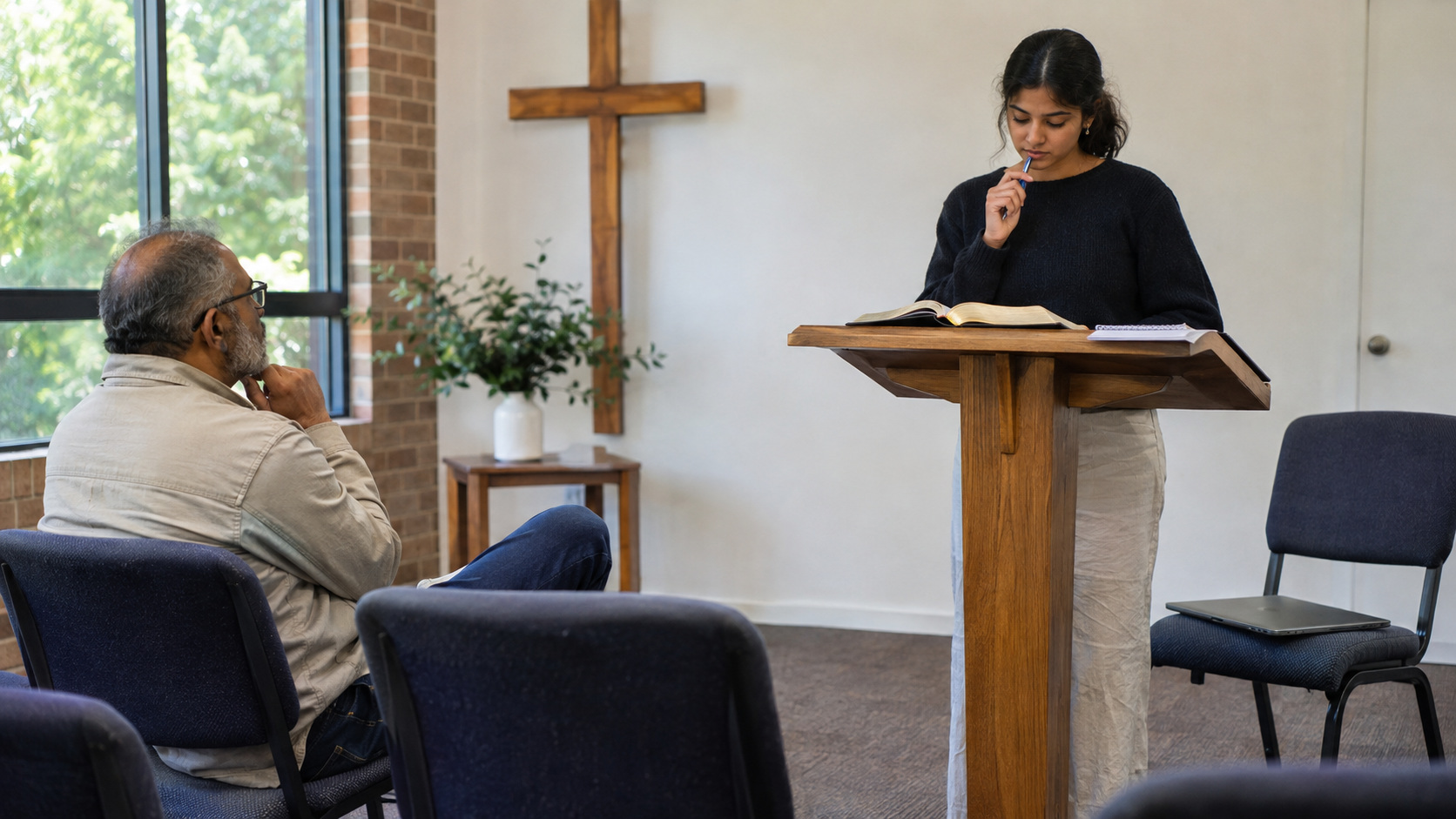
AI-generated illustration of a woman studying an open book at a church lectern while another person listens.
Editorial illustration
AI Faith Monitor

Published 2026-11-09 · 2 min read · AI-assisted reporting

Response November 2, 2026; original letter published October 27, sent September 30; Spectrum follow-up November 6 · Source checked 2026-11-09

A framework being developed

The president of the Seventh-day Adventist Church's Australian Union Conference says practical AI guidance is being developed to address human involvement in generated material and uses that should be avoided. Brendan Pratt made the commitment in a November 2 response published by Adventist Record. It is a statement of work underway, not a released policy. Source: record.adventistchurch.com

Pratt argues against a blanket prohibition while acknowledging risks to trust and creativity. He identifies translation and administrative support as potentially useful applications, and describes training and guidance across ministry and other parts of the church. His response does not supply a completed framework or a publication timetable.

Spectrum reported the exchange on November 6, citing Adventist Record. That later report brings attention to the commitment; it is not evidence that the promised guidelines have since been adopted. Source: spectrummagazine.org

The disagreement concerns the work itself

The response follows a letter by South Queensland secondary teacher Mitchell Strahan, published October 27 as a shortened version of a September 30 letter. Strahan describes concern about AI-generated church media and calls for greater investment in human creative contributors. He also questions what happens to the person preparing a Bible study when the difficult work is delegated. These are his observations and arguments, not a representative survey of Australian congregations. Source: record.adventistchurch.com

For ministry teams, the exchange suggests a distinction worth testing: checking an output and learning through producing it are different activities. A reviewer may correct an error without having done the interpretive work that the original assignment was intended to develop.

A question for the next staff conversation

Consider a hypothetical church asking a trainee to prepare a short Bible study. Before choosing a tool, the supervisor could identify what the trainee must practise: reading the passage, explaining its context and defending the proposed application. Assistance with formatting need not transfer those responsibilities to software. This is our practical suggestion, not a rule announced by the Australian Union Conference.

When the promised guidance appears, readers can ask whether it specifies who performs and checks those tasks, rather than treating a general commitment to human involvement as sufficient. We have not evaluated implementation or interviewed the participants.

Gifts exercised in service

First Peter 4:8–11 places the use of gifts within a community practising love, hospitality and service. Its instruction to serve with what one has received offers Christians a reason to develop contributors, not merely obtain content. Applying that principle to AI requires judgment about the particular task; the passage does not prescribe a software policy. 1 Peter 4:8–11, NIV 1 Peter 4:8-11 (NIV)

Sources & method

Adventist Record: Brendan Pratt's response on AI use

What this article establishes

A published institutional response and an earlier participant letter, with Spectrum's later report citing the same exchange. No new completed policy, release timetable or implementation evidence is established. Strahan's observations are not a representative survey. Practical scenario is hypothetical and Christian application is editorial interpretation. Produced with AI assistance under human editorial direction. The editor shapes the coverage and takes responsibility for the final published content.

How we use AI · Evidence standards

Related reading

An imagined Jewish educator workshop table with game pieces, planning cards, a notebook and laptop.
Editorial illustration

News brief / Faith & religious life

Jewish Futures program puts AI, games and educators’ choices on the same agenda

The October 26 program connects AI possibilities with learning design and educators’ decisions. This is advance coverage, not a report of classroom outcomes.

Published 2026-10-23 · Upcoming event October 26, 2026; organizer program checked October 23; page publication date not stated


An imagined church meeting room with an empty round table, laptop and notebooks.
Editorial illustration

News brief / Faith & religious life

Anglican AI policy work includes Indigenous knowledge and workers

An October progress report follows an August mandate in Aotearoa, New Zealand and Polynesia. The work is beginning, not a finished AI policy.

Published 2026-10-23 · Progress report October 20, 2026; adopted motion August 20; initial online meeting described as the preceding week, exact date not stated

An imagined English parish room with empty chairs, a laptop, notebooks and a church newsletter.
Editorial illustration

News brief / Faith & religious life

England ecumenical report puts quiet church AI adoption on the agenda

An October 22 account asks churches to discuss AI before its use becomes routine, pointing to existing guidance rather than announcing a new policy.

Published 2026-10-23 · Meeting report October 22, 2026; meeting described only as October; AICP guidelines launched July 14, 2026; current PDF revision date not established