
FAITH. TECHNOLOGY. PUBLIC ACCOUNTABILITY.
Research library

News brief

Belarus archbishop blesses AI-assisted image of Carlo Acutis

Named human contributors feature in the church report of a local devotional use of AI-assisted imagery.

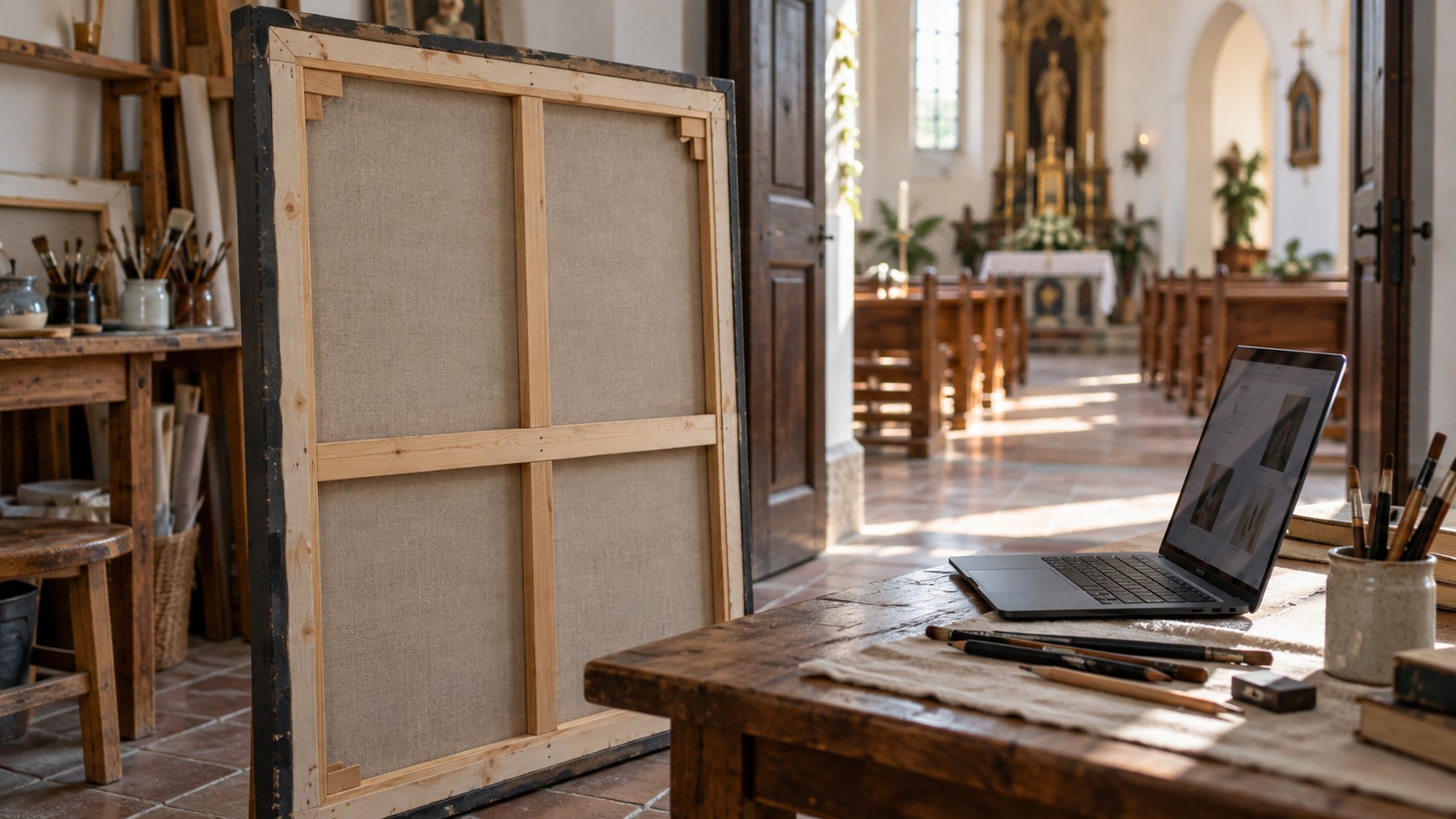
The back of a framed canvas stands beside a laptop and drawing tools in a church-art workspace.
Editorial illustration
AI Faith Monitor

Published 2026-10-13 · 2 min read · AI-assisted reporting

Event October 11, 2026; diocesan report October 12, 2026 · Source checked 2026-10-13

The October 11 blessing

Archbishop Tadeusz Kondrusiewicz blessed an AI-assisted image of Saint Carlo Acutis at St Mary Magdalene parish in Novolukoml, Belarus, on October 11. An October 12 report on the Vitebsk diocese’s Catholicnews.by, credited to Catholic.by, names three contributors: prompt engineer Dzmitry Kulpanovich, designer Andrei Kabanov and photographer Viktar Vedzen. It says they used AI and other modern technologies. Source: catholicnews.by

Those credits make “AI-assisted” the more precise description here. How the contributors divided the work between people and software remains unexplained.

Katolik.life separately reported the blessing on October 11, updating its article on October 12. It attributes the account of AI assistance to parish priest Mikalaj Lipski’s explanation during a livestream. Katolik.life identifies itself as a private initiative, rather than an official parish website. Source: katolik.life

Acutis was canonized by Pope Leo XIV on September 7, 2025. The Vatican’s record establishes that background independently of the Belarusian reporting. Source: vatican.va

What blessing an image signifies

The Catholic Church’s Directory on Popular Piety and the Liturgy explains that sacred images are blessed because of their religious function. For images of saints intended for public veneration, it connects the practice with following Christ through the saint’s example. It also assigns local ecclesiastical oversight a responsibility to prevent unsuitable images or those encouraging error or superstition. Sections 243–244 provide that context; they contain no assessment of generative AI. Source: vatican.va

The October 11 account therefore supports a bounded conclusion: an archbishop blessed this devotional image. It does not establish a Church-wide decision about AI art, certify a production system or demonstrate that this was the first such blessing anywhere.

A clearer question for church art commissions

For parish leaders commissioning religious imagery, this case makes authorship a concrete question. A useful commission record would identify who shaped the image, what the software contributed and who assessed its suitability for the intended devotional setting. Those are suggested questions, not a description of checks established in Novolukoml.

The blessing report does not identify the AI model, prompts or editing workflow. Without that record, readers can acknowledge the named contributors and the local religious act while leaving the extent of automated image-making unresolved.

Christian reflection on the people making the work

Exodus 31:1–11 places Bezalel, Oholiab and other skilled workers within God’s instructions for Israel’s tabernacle. Their abilities serve a particular religious purpose. The passage does not settle Christian disagreements about devotional images or authorize modern software. Exodus 31:1-11 (NIV)

Our application is to keep the people making religious work visible. A church can ask contributors to explain their choices, acknowledge assistance and take responsibility for what the finished work communicates. Crediting a tool alone would leave that conversation incomplete. Named makers give a congregation people to ask, learn from and hold accountable.

Sources & method

Catholicnews.by report, credited to Catholic.by

What this article establishes

Source-based brief with a separately labeled Christian reflection. Belarusian and Russian reports read and paraphrased in English; no interviews, production-file inspection or complete livestream review. Produced with AI assistance under human editorial direction. The editor shapes the coverage and takes responsibility for the final published content. AI-generated illustration of an imagined art workspace. It does not depict the Belarusian church, its image or the people involved.

How we use AI · Evidence standards

Related reading

An open reference book, annotated pages and a pencil lie on a wooden reading table.
Editorial illustration

Analysis / Faith & religious life

What human review means for a religious translation

Sefaria’s documented editorial work offers study leaders a practical question: which exact words were reviewed, and what happens when they are reused?

Published 2026-10-13 · Interview February 18, 2026; Assistant announcement August 10, 2026

A closed document folder and key sit on a wooden desk, with a closed laptop and an empty chair in a church office.
Editorial illustration

Report / Faith & religious life

Swiss churches’ AI guidelines draw a firm boundary around pastoral confidences

Five Christian bodies have issued shared guidance. A close comparison shows why checking a tool’s data terms and deciding what never enters it are separate tasks.

Published 2026-10-12 · Joint announcement October 12, 2026; linked German text marked September 3; discussion scheduled October 20