FAITH. TECHNOLOGY. PUBLIC ACCOUNTABILITY.
Research library

News brief

Parish-linked AI training reaches students and workers around Bethlehem

Parish-linked courses serve university students and employed adults. The next question is what learners can demonstrate, not whether attendance alone promises better jobs.

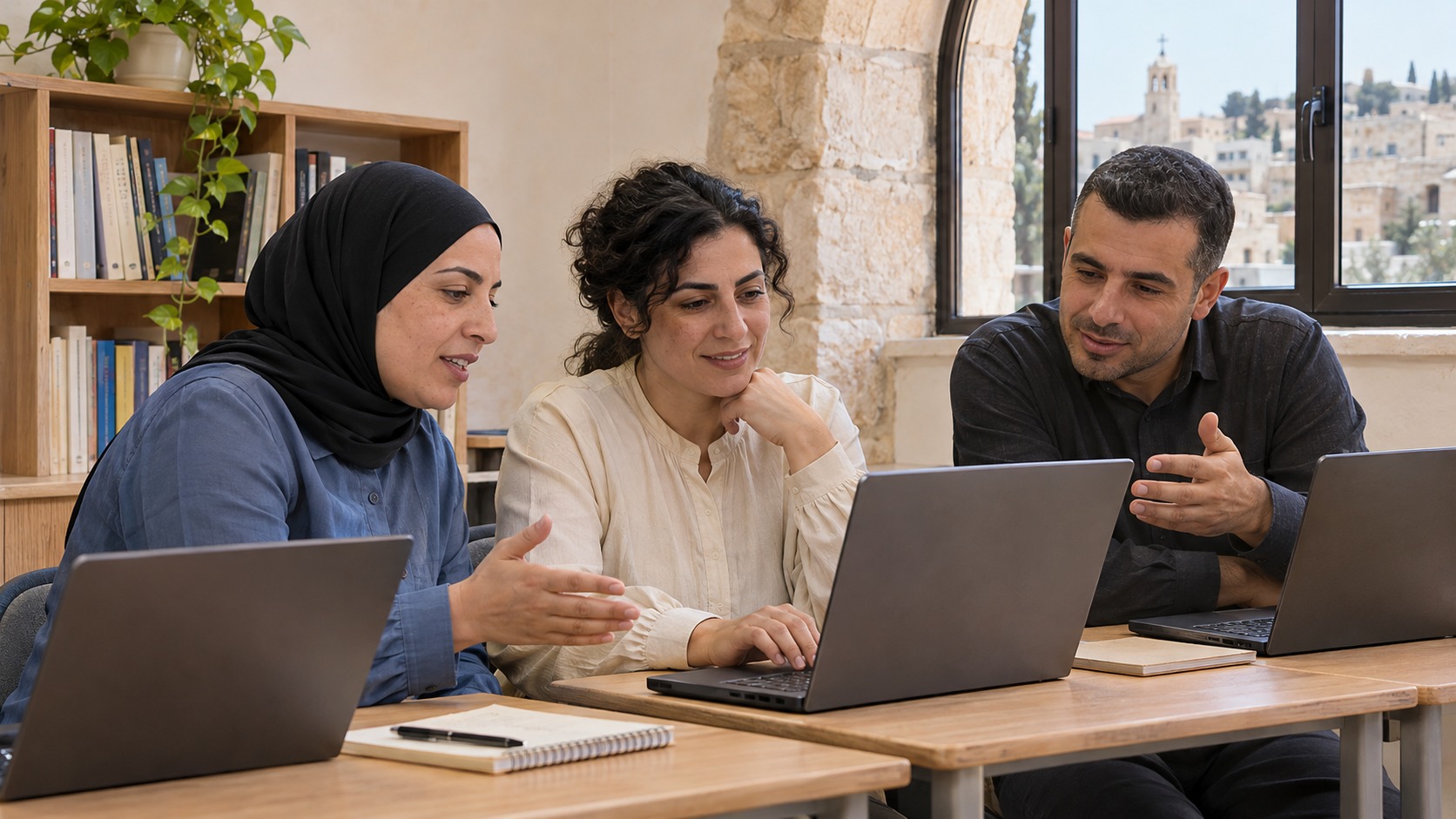
AI-generated illustration of three adult learners discussing laptops in an imagined community classroom.
Editorial illustration
AI Faith Monitor

Published 2026-11-04 · 2 min read · AI-assisted reporting

University report October 30, 2026; Abouna republication November 4; courses October 6–27 and October 19–November 9, with another concluding October 16 · Source checked 2026-11-04

Parish-linked training

A church-funded training programme is putting artificial intelligence on the timetable for university students and employed adults in the West Bank. The immediate development is an ongoing workplace course, scheduled to finish November 9, alongside two student courses completed in October. It is training activity, not evidence yet that AI has improved participants' earnings or job prospects.

According to a Bethlehem University account republished by Abouna on November 4, the university's Institute for Community Partnership runs the AFAQ initiative with funding from the Latin Patriarchate of Jerusalem. Its workplace course began October 19 with 21 employed participants from parishes in Bethlehem, Beit Jala and Beit Sahour.

The account also describes an online student course held October 6–27 with 22 participants from nine parishes, and an in-person course that concluded October 16 with 24 students. It does not establish whether anyone attended more than one course, so these figures should not be added into a count of unique beneficiaries. Abouna's university-origin report Source: en.abouna.org

What learners should be able to show

For parish learners and organisations considering similar training, a useful question is what someone can do more reliably afterwards, rather than simply whether they can produce an answer quickly. Our suggested test is practical: take a harmless sample task, complete it with AI assistance, and explain how the result was checked.

For example, in a hypothetical exercise using an invented event schedule, a participant could identify every date and venue in a generated announcement, compare them with the schedule, correct discrepancies and describe the checking process. A polished paragraph alone would not demonstrate that skill. This is an editorial illustration, not a description of AFAQ's curriculum or an observed classroom exercise.

Programme evaluation could likewise separate attendance from learning: ask participants to demonstrate a task before and after training, and later describe whether they still use the skill. Such a comparison would be more informative than assuming certificates translate into better employment. It would not, by itself, establish that a course caused a change in someone's career.

For Christian readers, Proverbs 14:15, NIV Proverbs 14:15 (NIV) places prudent consideration alongside a warning against believing indiscriminately. In its wisdom setting, the concern is how a person judges and acts. Applied here, it supports education that strengthens a learner's discernment rather than treating a machine's output as the end of the lesson.
Sources & method

Abouna: Bethlehem University AFAQ parish AI training

What this article establishes

The facts are attributed to a Bethlehem University account republished by Abouna, one underlying institutional source rather than independent outcome verification. The university report is dated October 30; Abouna republished November 4. October course dates and the November 9 scheduled finish are preserved. No unique combined participant total, employment gains, productivity improvement or participant religious identity is established. No interviews, broadcasts or firsthand classroom observation; the evaluation exercise and Christian application are explicitly editorial. Produced with AI assistance under human editorial direction. The editor shapes the coverage and takes responsibility for the final published content. AI-generated illustration of an imagined community classroom, not an actual AFAQ session or documented event.

How we use AI · Evidence standards

Related reading

An imagined Jewish educator workshop table with game pieces, planning cards, a notebook and laptop.
Editorial illustration

News brief / Faith & religious life

Jewish Futures program puts AI, games and educators’ choices on the same agenda

The October 26 program connects AI possibilities with learning design and educators’ decisions. This is advance coverage, not a report of classroom outcomes.

Published 2026-10-23 · Upcoming event October 26, 2026; organizer program checked October 23; page publication date not stated

An imagined church meeting room with an empty round table, laptop and notebooks.
Editorial illustration

News brief / Faith & religious life

Anglican AI policy work includes Indigenous knowledge and workers

An October progress report follows an August mandate in Aotearoa, New Zealand and Polynesia. The work is beginning, not a finished AI policy.

Published 2026-10-23 · Progress report October 20, 2026; adopted motion August 20; initial online meeting described as the preceding week, exact date not stated

An imagined English parish room with empty chairs, a laptop, notebooks and a church newsletter.
Editorial illustration

News brief / Faith & religious life

England ecumenical report puts quiet church AI adoption on the agenda

An October 22 account asks churches to discuss AI before its use becomes routine, pointing to existing guidance rather than announcing a new policy.

Published 2026-10-23 · Meeting report October 22, 2026; meeting described only as October; AICP guidelines launched July 14, 2026; current PDF revision date not established