
FAITH. TECHNOLOGY. PUBLIC ACCOUNTABILITY.
Research library

News brief

Builders AI Forum brings listening into Catholic AI development

A Rome gathering connects Catholic institutions with AI developers. For a parish considering a tool, listening can begin with the people expected to use it.

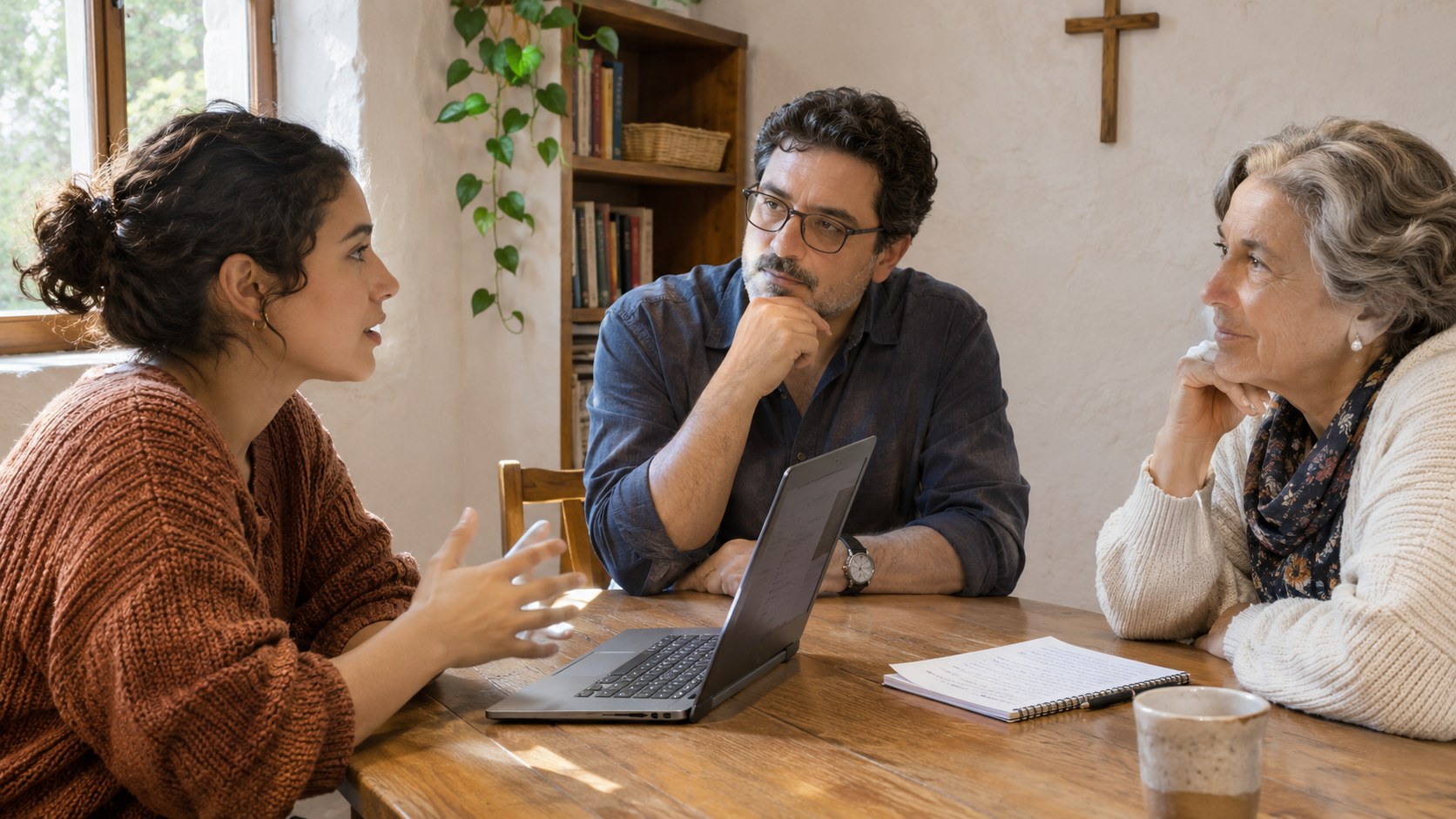
AI-generated illustration of three adults listening to one another around a laptop and notebook in an imagined parish room.
Editorial illustration
AI Faith Monitor

Published 2026-11-07 · 2 min read · AI-assisted reporting

Forum November 5–6, 2026; EWTN report November 6; university, organizer and sources checked November 7 · Source checked 2026-11-07

A forum and its stated aims

Catholic leaders, AI developers and investors gathered at the Pontifical Gregorian University in Rome on November 5–6 for the Builders AI Forum, according to EWTN’s event reporting. The university's own listing describes an effort to develop an interdisciplinary community supporting AI products for the Church's mission. It identifies the venue as the Collegium Maximum's Aula Magna and marks the event as restricted. Pontifical Gregorian University Source: unigre.it

In reporting published November 6, EWTN's Isabella Reed described Cardinal Michael Czerny's call for learning through dialogue. Bishop Stephen Wang also discussed the need to form seminarians' judgment about technology already present in their lives. These accounts put relationships and discernment alongside the technical work of developing religious AI tools. The comments are reported by EWTN; they are not a new Church-wide policy. EWTN News Source: ewtnnews.com

The forum's website lists four areas of work: evangelization, building and scaling AI, education, and healthcare. Its stated education focus includes teacher preparation and cooperation between schools, dioceses, universities and developers. Its development aims name human oversight and accountability. Those are the organizer's stated aims. The pages reviewed do not establish that particular products have passed an independent assessment. Builders AI Forum Source: baif.ai

A practical question for churches

Our suggested starting point is modest: before choosing a tool, ask the people who will use it to describe one task that needs help and one responsibility they must keep.

Consider a hypothetical parish team evaluating an AI assistant for an adult introductory course. A volunteer might want help finding passages in approved teaching materials. The course leader might insist that explanations remain traceable to those materials and that personal questions reach a person. A participant might want a straightforward way to say an answer was confusing.

The team could test those expectations with invented questions, without entering anyone's private circumstances. Record which source the assistant used, who checked the answer and how a learner could reach the course leader. Ask the provider to explain what happens when the system cannot support an answer. That exercise would produce a small, inspectable record of what the tool does in the parish's intended setting.

A Christian lens

James 1:19 urges believers to be “quick to listen, slow to speak and slow to become angry” (NIV). The surrounding passage connects hearing God's word with acting on it and caring for people in distress. Applied to a church technology decision, it invites patient attention to the people affected and a willingness to change course after hearing them. A listening exercise becomes useful when someone is responsible for responding to what it reveals. James 1:19–27, NIV James 1:19-27 (NIV)

Sources & method

EWTN News: Builders AI Forum reporting

What this article establishes

University and organizer pages establish dates and stated aims; EWTN supplies the attributed event reporting. No firsthand attendance, interviews, full speech transcripts, independent product tests or implementation outcomes. The organizer homepage still labels the dated event upcoming; no 2025 programme is used as a 2026 record. Practical example and Christian application are AI Faith Monitor’s interpretations. Produced with AI assistance under human editorial direction. The editor shapes the coverage and takes responsibility for the final published content. AI-generated editorial illustration of an imagined parish planning conversation, not the Builders AI Forum or Gregorian University.

How we use AI · Evidence standards

Related reading

An imagined Jewish educator workshop table with game pieces, planning cards, a notebook and laptop.
Editorial illustration

News brief / Faith & religious life

Jewish Futures program puts AI, games and educators’ choices on the same agenda

The October 26 program connects AI possibilities with learning design and educators’ decisions. This is advance coverage, not a report of classroom outcomes.

Published 2026-10-23 · Upcoming event October 26, 2026; organizer program checked October 23; page publication date not stated


An imagined church meeting room with an empty round table, laptop and notebooks.
Editorial illustration

News brief / Faith & religious life

Anglican AI policy work includes Indigenous knowledge and workers

An October progress report follows an August mandate in Aotearoa, New Zealand and Polynesia. The work is beginning, not a finished AI policy.

Published 2026-10-23 · Progress report October 20, 2026; adopted motion August 20; initial online meeting described as the preceding week, exact date not stated

An imagined English parish room with empty chairs, a laptop, notebooks and a church newsletter.
Editorial illustration

News brief / Faith & religious life

England ecumenical report puts quiet church AI adoption on the agenda

An October 22 account asks churches to discuss AI before its use becomes routine, pointing to existing guidance rather than announcing a new policy.

Published 2026-10-23 · Meeting report October 22, 2026; meeting described only as October; AICP guidelines launched July 14, 2026; current PDF revision date not established