
FAITH. TECHNOLOGY. PUBLIC ACCOUNTABILITY.
Research library

News brief

Comillas dialogue connects Catholic AI ethics with Ibero-American digital rights

A newly published account of the Madrid meeting places human dignity alongside a regional digital-rights charter. The existing document supplies concrete questions about inclusion; the accounts report discussion without a new agreement.

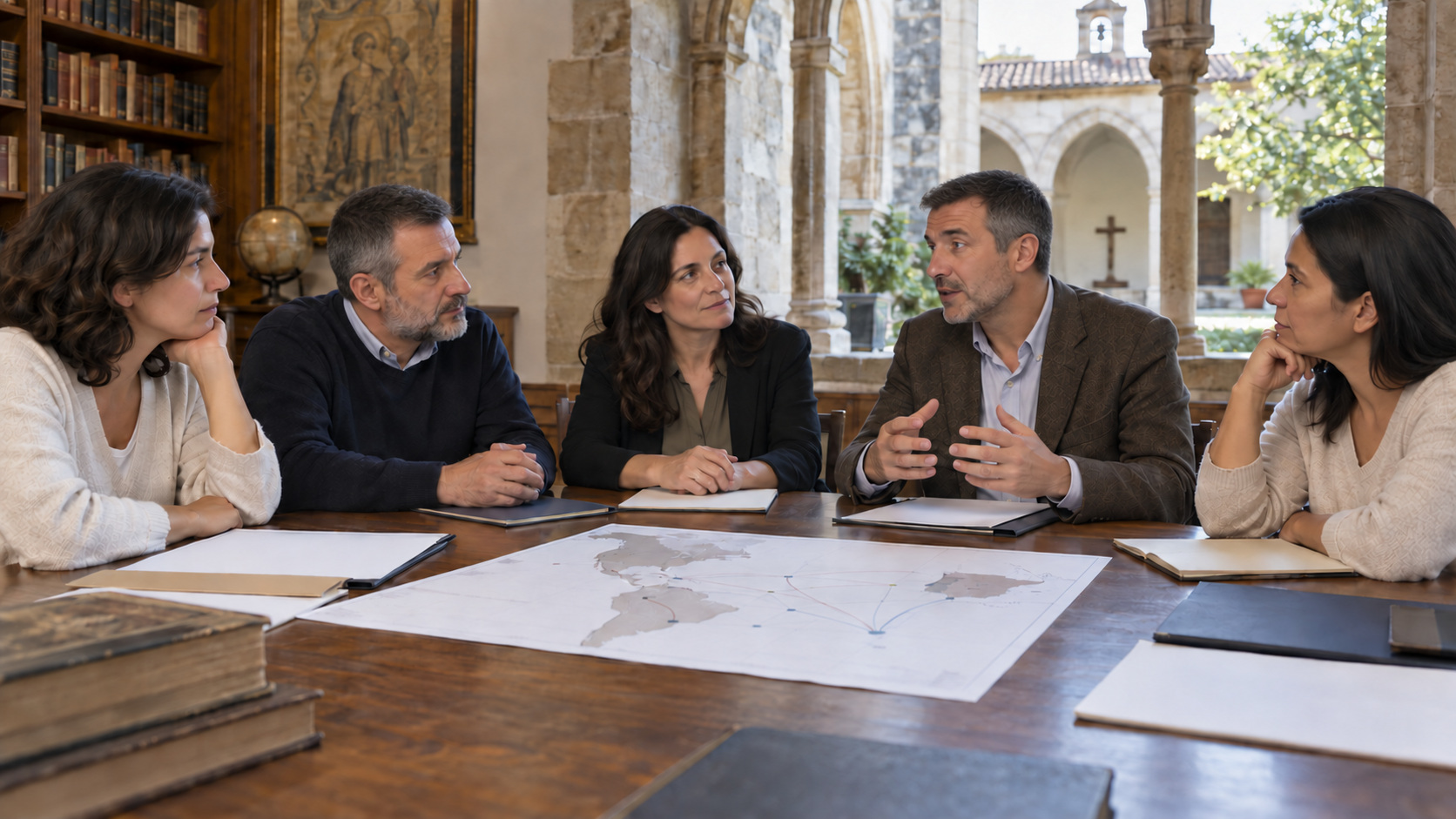
AI-generated conceptual illustration of five adult academic and civic participants discussing faith and AI governance around a table in a historic university setting.
Editorial illustration
AI Faith Monitor

Published 2026-10-02 · 2 min read · AI-assisted reporting

Event September 30, 2026; Comillas and Vatican News accounts October 1; digital-rights charter adopted March 25, 2023 · Source checked 2026-10-02

A meeting across two ethical frameworks

Cardinal Víctor Manuel Fernández and Ibero-American Secretary General Andrés Allamand met at Comillas Pontifical University in Madrid on September 30 to discuss people-centered AI. The university's October 1 account says the dialogue drew on Pope Leo XIV's Magnifica Humanitas and the Ibero-American Charter of Principles and Rights in Digital Environments. Allamand called for a coherent regional approach, while a subsequent panel examined regulation, rights, concentrated technological power and inequality. Source: comillas.edu

Vatican News, also reporting October 1, describes Fernández advocating complementarity between technology and humanity in service of dignity and the common good. Its account includes his question about who can limit the power accumulating among people with greater access to technological advances. These are attributed arguments, rather than evidence that participants agreed on a regulatory mechanism. Source: vaticannews.va

What the charter actually adds

The charter was adopted in Santo Domingo on March 25, 2023. Its introduction explicitly describes it as declarative and non-binding. It aims to guide national legislation, public policy and the development and use of technology without changing domestic law by itself. It was already in existence when the Madrid discussion took place. Source: segib.org

Its provisions give the conversation a more specific vocabulary. Section 2 treats inclusion as involving affordability, language, training, local content and accessibility. Section 7 says people should not be disadvantaged in dealing with public administration because they cannot or do not wish to use electronic means. Section 9 calls for safe, ethical and responsible emerging technologies with participation by multiple stakeholders. These are commitments in the charter, not verified achievements.

From common language to a concrete question

Read together, the meeting and charter suggest an avenue for religious participation more precise than endorsing “human-centered AI.” A church-run service could ask whether introducing an AI interface makes help harder to obtain in someone's language, or for someone with limited digital skills. A public advocate could ask how an existing inclusion commitment is reflected in the design of a particular service.

Those are AI Faith Monitor's proposed applications, not decisions announced at Comillas. The inspected meeting accounts do not announce a signed agreement or a new enforcement body. The useful next evidence would identify a specific proposal, the institution responsible and the way affected people can respond.

Christian perspective: authority measured by service

In Mark 10:35–45, James and John seek places of honor. Jesus answers the disciples' struggle over status by distinguishing their calling from rulers who dominate others: “whoever wants to become great among you must be your servant.” The passage culminates in his own self-giving mission. Its subject is discipleship, not the design of a modern international institution. Mark 10:35-45 (NIV)

As a Christian application, it challenges religious participants to measure influence by service rather than proximity to powerful people. Bringing a charter into dialogue with theology becomes useful when it sharpens attention to people who encounter an actual barrier. That requires both moral conviction and patient examination of how a service works. A dignified welcome should remain recognizable to the person seeking help, including the person who cannot use the preferred technology.

Sources & method

Comillas: Vatican–SEGIB dialogue on human-centered AI

What this article establishes

This brief compares the university and Vatican News accounts of the September 30 dialogue with the original 2023 digital-rights charter. The accounts document discussion, not a new agreement or verified implementation. Applications to church-run services and the Christian interpretation are AI Faith Monitor’s analysis.

How we use AI · Evidence standards

Related reading