FAITH. TECHNOLOGY. PUBLIC ACCOUNTABILITY.
Research library

News brief

United Methodist bishops put AI on their agenda as local church bodies set their own boundaries

A global bishops’ meeting is scheduled to discuss the church’s response. An existing regional ministry board policy shows how practical rules can differ from a churchwide decision.

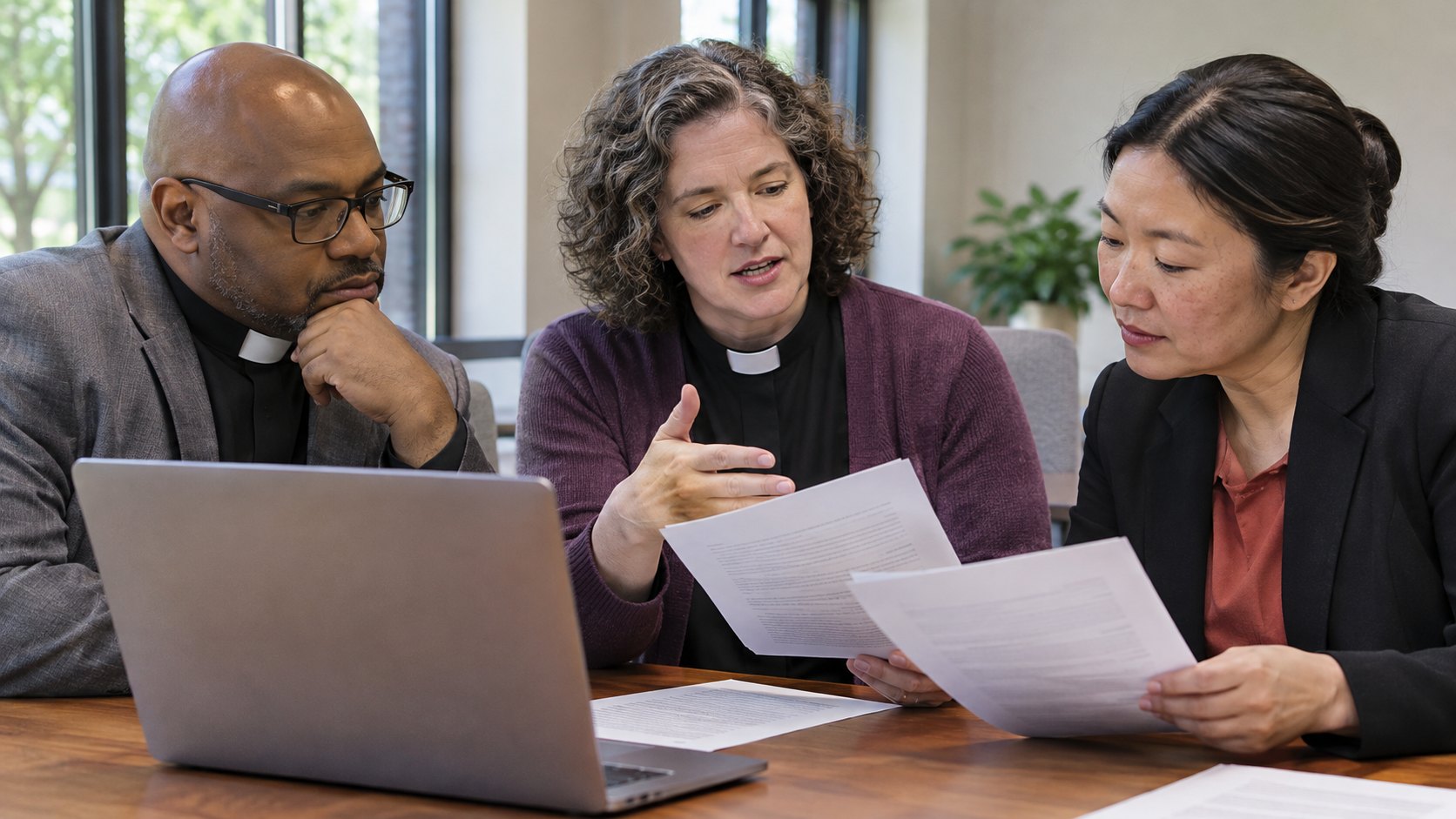
Three adults review papers beside a laptop in an imagined church meeting room.
Editorial illustration
AI Faith Monitor

Published 2026-11-03 · 2 min read · AI-assisted reporting

Meeting November 2–6, 2026; agenda November 2; regional policy revised January 28 and historical report 2026 · Source checked 2026-11-03

A meeting agenda and existing local examples

The United Methodist Council of Bishops has placed the church’s response to artificial intelligence on the agenda for its November 2–6 online meeting. Bishops from Africa, Asia, Europe and the Americas are expected to take part, according to the council’s November 2 announcement.

The notice identifies AI as one item alongside immigration, earth care and church finances. It does not say when the AI discussion will occur, what proposal will be considered or whether the bishops will issue guidance. A scheduled conversation is not a decision, and the announcement does not establish a new denomination-wide policy. Source: unitedmethodistbishops.org

For clergy and congregations, one question to watch is how a broad discussion would translate into decisions people can use: who checks an AI-assisted text, what information may be entered into a tool and who can answer when something goes wrong? Existing regional documents show that these questions are already being addressed, but at different levels of church life.

The Desert Southwest Board of Ordained Ministry’s guidelines, revised January 28, 2026, tell certified, provisional and full-member candidates writing papers for the board to explain where and how they used AI, including editing, verify information independently and obtain consent before sharing information about another person, including in examples from congregational care. The board also says noncompliance can affect the candidacy evaluation process. These are that board’s instructions for its setting, not a policy announced by the global bishops’ meeting. Source: dscumc.org

Michigan’s 2026 conference historical report describes an eight-member task force developing guidance for conference communications and ministry. Its communications team reported that AI is a tool requiring human review and editing. The report records work already undertaken in Michigan; it does not establish that guidance was adopted or that every United Methodist church follows the same process. Source: 2026.michiganumc.org

The distinction matters when a church drafts a notice versus when a minister considers entering a pastoral conversation into an AI service. Both might look like writing tasks, but the second involves another person’s confidence. The Desert Southwest example makes consent explicit; a local church would still need to determine its own responsibilities and the tool’s data practices.

For Christians, Paul urges believers to restore someone gently and carry each other’s burdens in Galatians 6:1–2. That call to care can guide how a church protects another person’s confidence, though it does not establish a technical privacy standard. Galatians 6:1-5 (NIV)

What to watch next: whether the bishops publish a statement, identify a responsible body or provide a timetable after their discussion. Until then, local documents remain examples of existing practice, not evidence of a new churchwide ruling.
Sources & method

United Methodist Council of Bishops: November 2–6 meeting agenda

What this article establishes

Based on the council’s agenda announcement and existing documents from two United Methodist regional bodies. The agenda does not establish that the AI discussion occurred, a policy was adopted or outcomes were achieved. No livestream, interviews or firsthand reporting. Practical comparison and scriptural application are editorial interpretations. Produced with AI assistance under human editorial direction. The editor shapes the coverage and takes responsibility for the final published content. AI-generated editorial illustration of an imagined church meeting, not the bishops’ actual meeting.

How we use AI · Evidence standards

Related reading

An imagined Jewish educator workshop table with game pieces, planning cards, a notebook and laptop.
Editorial illustration

News brief / Faith & religious life

Jewish Futures program puts AI, games and educators’ choices on the same agenda

The October 26 program connects AI possibilities with learning design and educators’ decisions. This is advance coverage, not a report of classroom outcomes.

Published 2026-10-23 · Upcoming event October 26, 2026; organizer program checked October 23; page publication date not stated

An imagined church meeting room with an empty round table, laptop and notebooks.
Editorial illustration

News brief / Faith & religious life

Anglican AI policy work includes Indigenous knowledge and workers

An October progress report follows an August mandate in Aotearoa, New Zealand and Polynesia. The work is beginning, not a finished AI policy.

Published 2026-10-23 · Progress report October 20, 2026; adopted motion August 20; initial online meeting described as the preceding week, exact date not stated

An imagined English parish room with empty chairs, a laptop, notebooks and a church newsletter.
Editorial illustration

News brief / Faith & religious life

England ecumenical report puts quiet church AI adoption on the agenda

An October 22 account asks churches to discuss AI before its use becomes routine, pointing to existing guidance rather than announcing a new policy.

Published 2026-10-23 · Meeting report October 22, 2026; meeting described only as October; AICP guidelines launched July 14, 2026; current PDF revision date not established