FAITH. TECHNOLOGY. PUBLIC ACCOUNTABILITY.
Research library

News brief

Phnom Penh AI workshop puts human contact alongside tool skills

Participants raised different concerns about judgment and relationships. A parish training exercise can make the conversation worth preserving visible before a new workflow is adopted.

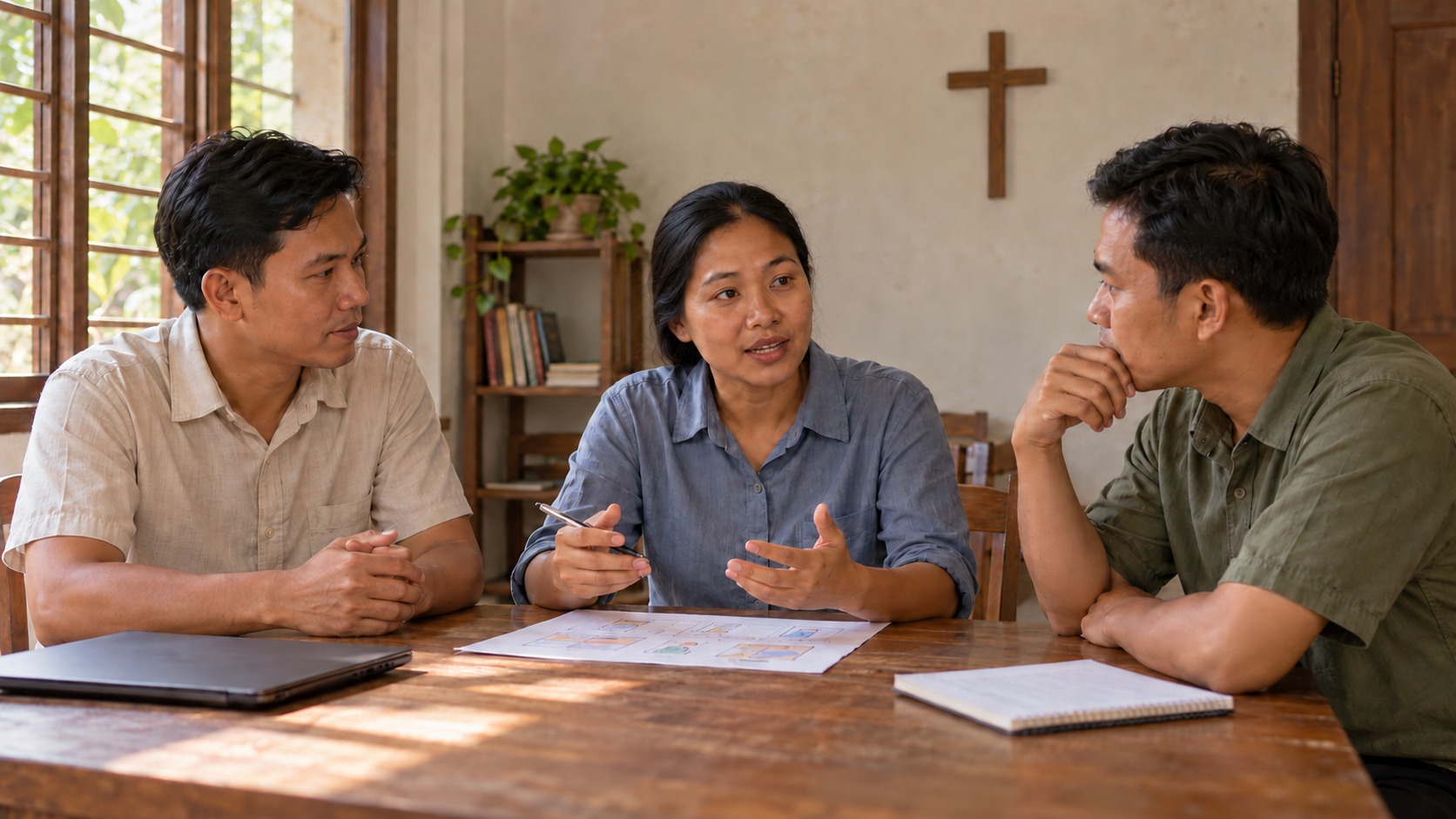
Three imagined adult parish volunteers discuss a paper plan beside a closed laptop.
Editorial illustration
AI Faith Monitor

Published 2026-10-26 · 2 min read · AI-assisted reporting

Workshop October 19–21; RVA report October 23, 2026 · Source checked 2026-10-26

Learning tools without losing contact

A Catholic AI workshop in Phnom Penh paired practical instruction with concern for the relationships technology might displace. Radio Veritas Asia’s October 23 report says about 70 clergy, religious and laypeople attended the October 19–21 event, organized by the Cambodian Catholic National Office for Social Communications. Participants explored tools including ChatGPT, Gemini and Canva.

The account records two different priorities. Teacher Sok Rotana planned to share his learning while keeping students’ own judgment central. Parish assistant Leng Hong urged people to keep talking with those around them, rather than allowing technology to displace personal connection. These are participants’ stated intentions and concerns; the report does not evaluate what changed afterward. Source: rvasia.org

Keep a conversation in the plan

For a parish preparing its own training, those priorities suggest separate questions. Can a participant evaluate an answer? And does the proposed use leave people with a real opportunity to speak and be heard? A technically correct message can pass the first test without answering the second.

Consider a hypothetical parish workshop on preparing notices for a community activity. Alongside the draft notice, the trainee could identify one conversation that the activity still requires: asking a volunteer about access needs, explaining an unfamiliar arrangement or hearing why somebody cannot take part. The exercise would name who will have that conversation and how people can respond. It would use invented details, not upload personal information about parishioners.

The group could then compare the proposed workflow with its existing practice. Is the tool helping someone prepare for that exchange, or quietly removing the exchange from the plan? A notice that directs a person to a reachable organizer has a different role from an automated answer that closes the discussion. Neither the polish of the wording nor the speed of production settles that choice.

This is an editorial exercise, not a method documented or tested in Cambodia. Its purpose is modest: make the intended human contact visible before a parish adopts a workflow. It should not become a requirement to collect more personal information or turn every routine announcement into a compulsory conversation.

James 1:19–25 joins careful listening and restrained speech to receiving and acting on God’s word. For Christian trainers, one practical application is to leave room for people’s replies rather than equate a larger volume of messages with better service. The passage supplies a principle for present-day judgment, not a prediction about AI. James 1:19-27 (NIV)
Sources & method

RVA Khmer service: workshop report

What this article establishes

Based on an inspected church-media report; no interviews or evaluation of subsequent practice. The parish exercise is hypothetical. AI-assisted draft; human factual review is not attested. Produced with AI assistance under human editorial direction. The editor shapes the coverage and takes responsibility for the final published content. AI-generated illustration of an imagined parish planning conversation, not the Phnom Penh workshop or its participants.

How we use AI · Evidence standards

Related reading

An imagined Jewish educator workshop table with game pieces, planning cards, a notebook and laptop.
Editorial illustration

News brief / Faith & religious life

Jewish Futures program puts AI, games and educators’ choices on the same agenda

The October 26 program connects AI possibilities with learning design and educators’ decisions. This is advance coverage, not a report of classroom outcomes.

Published 2026-10-23 · Upcoming event October 26, 2026; organizer program checked October 23; page publication date not stated

An imagined church meeting room with an empty round table, laptop and notebooks.
Editorial illustration

News brief / Faith & religious life

Anglican AI policy work includes Indigenous knowledge and workers

An October progress report follows an August mandate in Aotearoa, New Zealand and Polynesia. The work is beginning, not a finished AI policy.

Published 2026-10-23 · Progress report October 20, 2026; adopted motion August 20; initial online meeting described as the preceding week, exact date not stated

An imagined English parish room with empty chairs, a laptop, notebooks and a church newsletter.
Editorial illustration

News brief / Faith & religious life

England ecumenical report puts quiet church AI adoption on the agenda

An October 22 account asks churches to discuss AI before its use becomes routine, pointing to existing guidance rather than announcing a new policy.

Published 2026-10-23 · Meeting report October 22, 2026; meeting described only as October; AICP guidelines launched July 14, 2026; current PDF revision date not established