

FAITH. TECHNOLOGY. PUBLIC ACCOUNTABILITY.
Research library

News brief

California Episcopal proposal would connect church AI guidance with developer engagement

A pending proposal connects ministry guidance with public engagement on AI.

Unmarked folders and pencils are arranged around a table in an empty church meeting room.
Editorial illustration
AI Faith Monitor

Published 2026-10-12 · 2 min read · AI-assisted reporting

Resolution updated October 8, 2026; convention scheduled October 23–24 · Source checked 2026-10-13

A proposal with two areas of responsibility

An October 8 revision to a Diocese of California resolution proposes an AI task force with responsibilities inside and beyond church institutions. It would develop guidance for ministry and governance, including liturgy, while supporting AI literacy and attention to vulnerable people and the environment. The resolution is committee-reviewed and remains a proposal. Source: diocalconvention.org

The proposed group would advise the bishop and General Convention deputation about developments including autonomous AI agents. It could also communicate on the diocese’s behalf with developers, financiers and public leaders, urging human flourishing, safeguards and communal oversight over an unrestricted competitive race toward artificial general intelligence.

Members would be appointed by the bishop or designees, drawing on technological, theological, ethical and justice expertise. The text calls for a report to the 178th convention and a final report to the 179th. It anticipates no additional diocesan budget costs for 2027 or 2028.

The vote is still ahead

The convention’s proposed agenda, prepared October 6, schedules consideration of the AI task-force resolution at 1:50 p.m. on October 24 at Grace Cathedral. Convention begins online the previous evening. These are planned proceedings, not evidence that delegates have approved the resolution. Source: diocalconvention.org

A separate data-center shareholder resolution is scheduled later that afternoon. AI Faith Monitor previously reported on that proposal’s investment approach. It should be followed as a separate decision, with its own text and voting outcome. Source: aifaithmonitor.org

What local leaders could learn

Our reading is that the proposed structure raises a useful coordination question: how would experience inside congregations inform what church representatives ask of AI companies? A parish discovering a problem with an automated translation might need immediate guidance. A public conversation about autonomous systems could require a different kind of expertise and a longer timetable.

If delegates adopt the proposal, useful evidence of progress would include a clear route for submitting local questions, identifiable responsibility for interim advice, and public explanations of any external recommendations. Those are suggested accountability tests; they are not provisions we have verified in the resolution.

Other Christian church bodies considering an AI committee could ask the same practical question before appointing one: who receives a congregation’s urgent problem while the wider study continues? Establishing a group would begin that work. Readers should look next for the actual convention decision, any amendments and the responsibilities ultimately assigned.

Sources & method

Diocese of California, Resolution 1: Task Force on Artificial Intelligence

What this article establishes

Pending resolution and proposed agenda; no adoption verified. Practical accountability tests are AI Faith Monitor analysis. Produced with AI assistance under human editorial direction. The editor shapes the coverage and takes responsibility for the final published content. AI-generated illustration of an imagined meeting room; it does not depict Grace Cathedral or the diocesan convention.

How we use AI · Evidence standards

Related reading

A closed document folder and key sit on a wooden desk, with a closed laptop and an empty chair in a church office.
Editorial illustration

Report / Faith & religious life

Swiss churches’ AI guidelines draw a firm boundary around pastoral confidences

Five Christian bodies have issued shared guidance. A close comparison shows why checking a tool’s data terms and deciding what never enters it are separate tasks.

Published 2026-10-12 · Joint announcement October 12, 2026; linked German text marked September 3; discussion scheduled October 20

A face-down phone and notebook sit on a low shelf beside a prayer rug in a sunlit mosque interior.
Editorial illustration

News brief / Faith & religious life

Elshinawy sermon puts purpose before speed in AI use

A QIBLA framework connects Muslim obligations with practical choices about technology.

Published 2026-10-12 · Video published October 10, 2026; republished October 12; delivery date unconfirmed

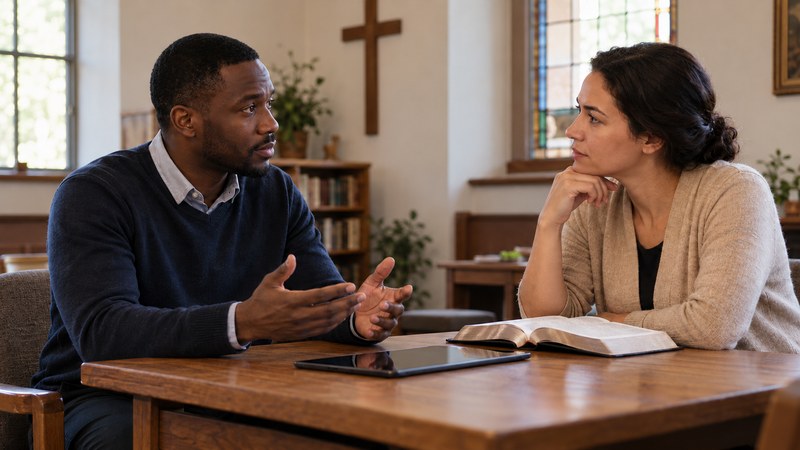
Two adults discuss an open book beside a tablet in a church meeting room.
Editorial illustration

Research brief / Faith & religious life

New paper asks how AI answers acquire religious authority

A conceptual framework offers educators a question: what happens after an AI conversation?

Published 2026-10-12 · Comment published October 12, 2026; accepted August 10, 2026