
FAITH. TECHNOLOGY. PUBLIC ACCOUNTABILITY.
Research library

News brief

San José faith voices bring stewardship into the data-center standards debate

The practical question for congregations is how proposed protections could become commitments neighbors can check.

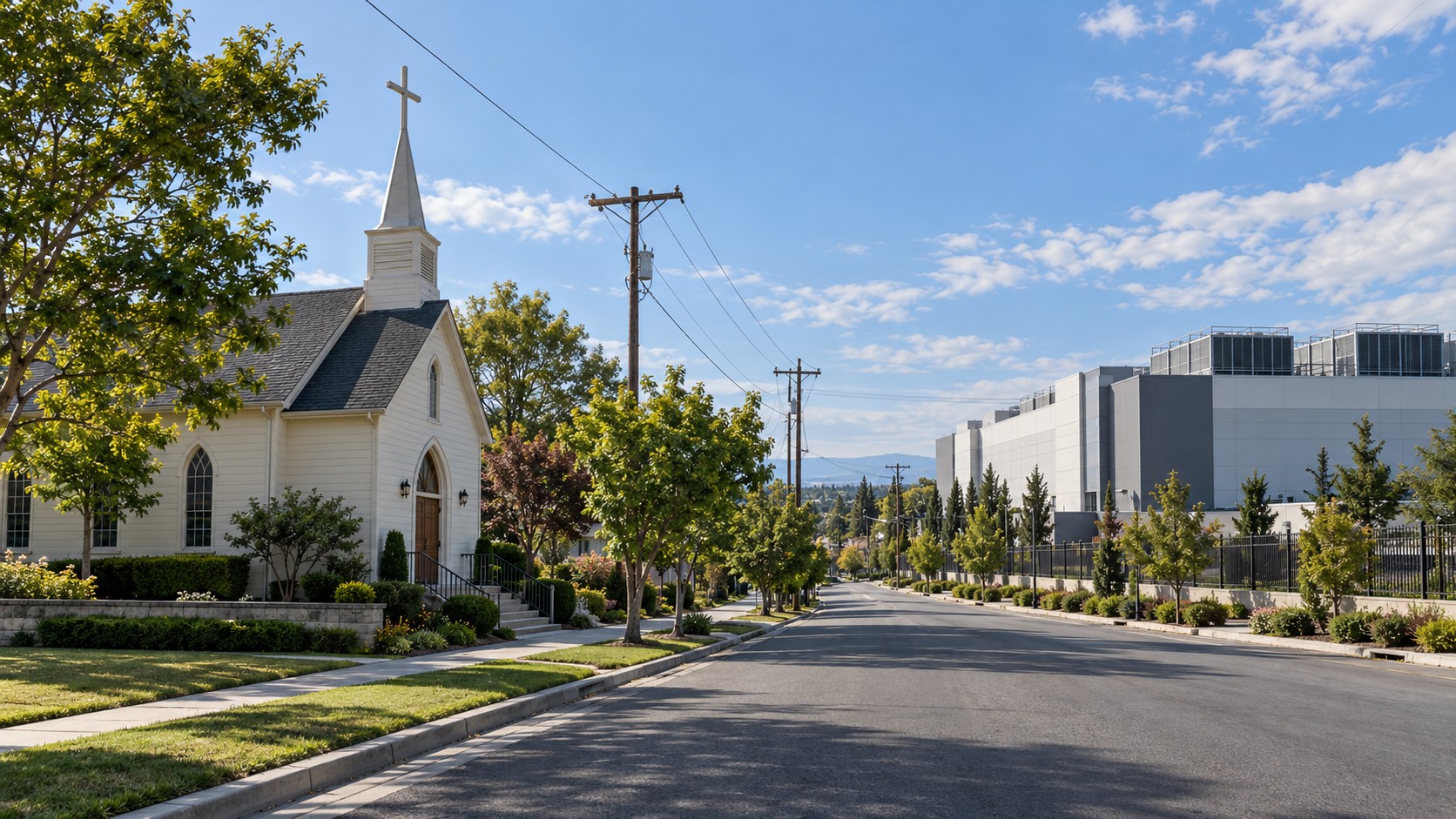
Imagined neighborhood street with a church on one side and a large data-center building on the other, with trees and utility lines.
Editorial illustration
AI Faith Monitor

Published 2026-10-17 · 2 min read · AI-assisted reporting

Meeting October 15; reporting October 16, 2026 · Source checked 2026-10-17

The meeting and competing judgments

Faith leaders are participating in San José’s debate over standards for data centers. At an October 15 community meeting, the question was what protections residents should expect as the city considers rules for large energy projects.

In its October 16 account, KTVU reported that residents, faith leaders and youth activists attended, with many calling for a pause in development. The station interviewed Matthew McHale, identified as a minister with the South Bay Interfaith Climate Justice Network. He connected his concern about data centers to religious responsibility for people and the natural world. Residents also questioned the reach of public communication, including outreach across languages.

Mayor Matt Mahan offered a different conclusion in the same report: digital infrastructure would continue to be needed, and the city should establish strong standards rather than halt development. Those are competing judgments about how to proceed. The meeting itself does not settle the environmental consequences of an individual facility. KTVU Source: ktvu.com

A concrete route for religious participation

An institutional invitation helps establish that the religious connection was more than an incidental remark in television coverage. The Diocese of San José listed a youth-organized press conference outside City Hall for October 15, followed by the community listening session, and invited public comment. That listing establishes circulation of an opportunity to participate. It does not establish a diocesan position on every demand made that evening. Diocesan listing Source: dsj.org

What the draft would require

The city’s October 9 release describes proposals, not adopted protections. Among them are cooling based on recycled water or low-water technologies, a prohibition on potable-water open-loop cooling, carbon-neutral electricity, and annual checks of energy and water use against environmental-review assumptions. It also describes noise monitoring near homes and a wider public-notification radius.

The release schedules Planning Commission consideration for November 18 and tentatively identifies December 8 and 15 for Council readings. Its detailed summary remains a statement of the proposal at that date, subject to change. City-authored release, reproduced by Public Technologies Source: pubt.io

Turning stewardship into questions that can be answered

For Christian readers, Genesis 2:15 (NIV) Genesis 2:15 (NIV) places human work within a responsibility to care for the garden God gives. Applying that concern to infrastructure does not produce an automatic verdict for or against a project. It does encourage attention to the resources a facility uses and the people who live beside it.

For a congregation trying to assess a nearby project, the useful distinction is between a promised safeguard and a safeguard whose performance can be checked. What information will neighbors receive? Who will verify it? What happens if actual use or noise exceeds the assumptions presented when a project was approved?

Those are questions for subsequent decisions and implementation, not findings that the present draft succeeds or fails. They also leave room for disagreement about whether stronger conditions are sufficient or a pause is necessary.

AI depends on physical infrastructure, but not every data center serves AI alone. A careful faith response therefore needs both a moral concern for neighbors and a project-specific account of what is proposed. San José’s debate shows one place where those responsibilities meet: the details through which public commitments could become enforceable practice.

Sources & method

KTVU report on San José’s data-center meeting

What this article establishes

Source-based reporting with separately labeled Christian interpretation. No interviews or facility assessment. City summary is the October 9 proposal; current official standards page was inaccessible. AI-generated editorial illustration of an imagined church, street and data center; it does not depict an actual San José location or proposed facility.

How we use AI · Evidence standards

Related reading

Imagined publishing workspace with music sheets, printed artwork, a closed laptop and pencil, with a small wooden cross on a bookshelf.
Editorial illustration

News brief / Work & creation

Benanti asks who benefits when AI trains on Australian creative work

The Franciscan ethicist puts creators and local benefit at the center of a debate whose consultation options remain distinct from policy decisions.

Published 2026-10-15 · ABC interview published October 14, 2026; interview date unspecified
AI-generated conceptual illustration of three adults examining a planning sheet outside an imagined church, with computing infrastructure in the distance; not the Wichita venue or an actual project.
Editorial illustration

Report / Work & creation

Wichita faith forum puts data-center safeguards on the community agenda

A planned church gathering brings stewardship into a live zoning debate. Existing electricity protections and proposed local requirements show why the details matter.

Published 2026-10-03 · Forum scheduled October 4, 2026; planning documents September 24; electricity tariff approved November 6, 2025

A conceptual wooded river corridor with an industrial campus in the distance; not the King George site.
Editorial illustration

Report / Work & creation

King George and AWS reach data-center deal with riverfront limits

A newly announced agreement combines a planned $6 billion campus with a school contribution and a restriction on river-adjacent buildings. Its public value will depend on the details that follow.

Published 2026-09-30 · Source 2026-09-29